F1blogtech

F1blogtech

domenica 9 settembre 2018

L'Analisi Prestazionale del Gran Premio d'Italia 2018


"DOV'E' LA VITTORIA"
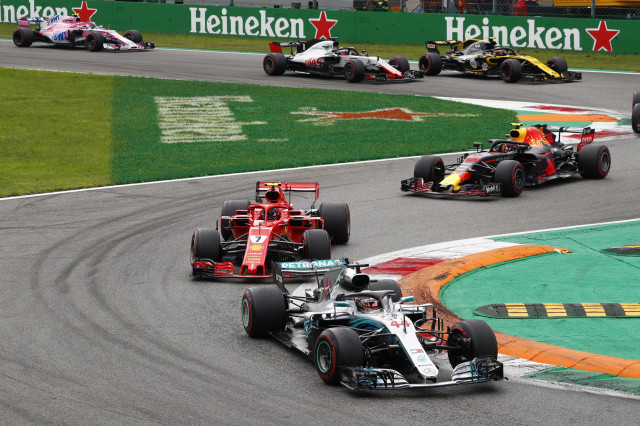
Risultati immagini per F1 Italian Gp 2018 Mercedes

COSA E' STATO APPRESO DAL VENERDI'
E' stato un venerdi difficile quello del Gran Premio di Monza, segnato dalla pioggia che ha monopolizzato le prove libere 1. Ciò ha creato problemi ai  Team nella ricerca dell'assetto ottimale della vettura. Le squadre hanno quindi concentrato tutto il lavoro nella seconda sessione di libere.

La gomma media è stata fin da subito scartata e non è stata provata dai top team durante le simulazioni. La gomma SuperSoft, la più morbida del lotto, si è comportata piuttosto bene nei corti long run che i Team hanno portato avanti durante le libere. Era quindi chiaro che la gomma da usare alla partenza sarebbe stata la SS e per forza di cose, esclusa la Media e cercando di rimanere sulla sola sosta, la gomma del secondo stint sarebbe stata la gomma HighWorkingRange Soft.

La strategia a due soste era notevolmente più lenta anche per il fatto che su questo circuito si perde moltissimo tempo per effettuare la sosta. Il plan a due soste sarebbe potuto realizzarsi solamente se a fine gara si sarebbe presentata l'opzione di un free stop sotto regime di Safety Car come è accaduto più volte all'inizio di questo campionato.

Per coloro che partivano con la Soft nelle posizioni più arretrate, nel caso di una Safety Car tra il giro 15-20, molto prima della loro effettiva sosta, avrebbero potuto montare la Media. In questo modo avrebbero approfittato del regime di SC per effettuare lo stop rimanendo però sulla strategia ad unico pit.


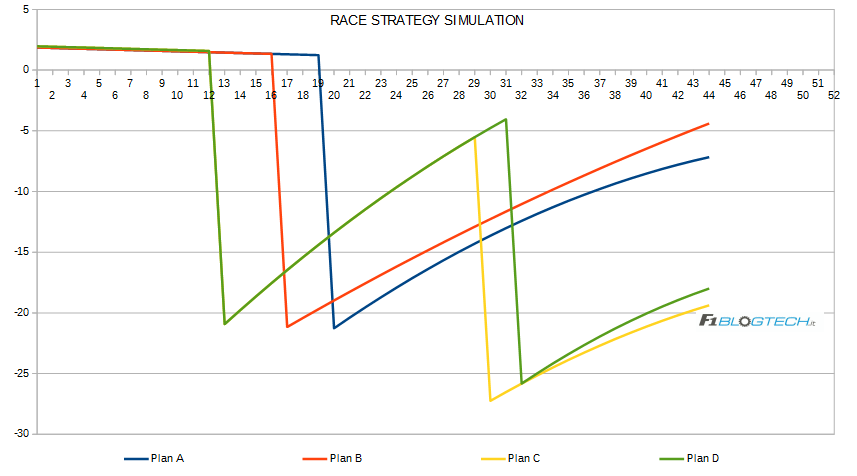
LA STRATEGIA DI GARA

LE CONDIZIONI DELLA PISTA
La temperatura dell'asfalto durante la gara è stata da 30°C mentre quella dell'aria si è tenuta sui 22°C.
Si ipotizzava l'arrivo della pioggia a fine gara, ma è rimasta solamente un'ipotesi.

UN BREVE RIASSUNTO DEL GRAN PREMIO D'ITALIA
Allo start Vettel e Raikkonen hanno coperto la posizione su Hamilton. L'inglese, però, ha provato l'attacco su Vettel all'esterno di curva 04 lasciando il giusto spazio al pilota tedesco che però non è riuscito a percorrere la curva e ha toccato la fiancata della Mercedes finendo in testacoda. Dopo lo stop, la Mercedes ha stretto in un Sandwich la vettura di Kimi che dopo alcuni giri ha avuto un blistering marcato sulle sue mescole. A quel punto l'inglese ha sopravanzato Raikkonen con più facilità e ha portato a casa la vittoria. Bottas, dopo lo stop, non è riuscito a sorpassare Verstappen in pista, ma è salito comunque sul podio a causa di una penalità di 5s assegnata all'olandese.

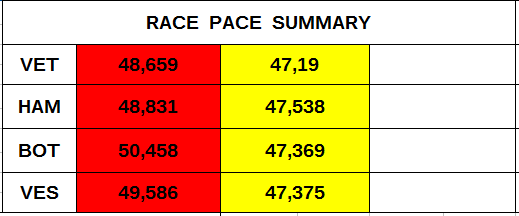
Proponiamo, prima dell'analisi della gara, un tabella riassuntiva dei passi gara tenuta dai piloti nei due stint.

PERCHE' RAIKKONEN NON E' RIUSCITO A CREARE UN GAP SU HAMILTON?
Il passo della Mercedes durante i primi giri è stato inaspettatamente molto competitivo. Ciò è stato anche dovuto, in parte, alla gestione della vettura da parte di Hamilton, nonchè dalla bravura del team nel settare al meglio la vettura e contenere i problemi di surriscaldamento del posteriore. I due sono quindi sempre stai sul gap del secondo e mezzo, un gap non sufficiente a Raikkonen per gestire la gara in sicurezza.

PERCHE' VETTEL HA MONTATO LA SOFT DOPO LA TOCCATA CON HAMILTON ?
Gli strateghi Ferrari hanno deciso di montare la gomma Soft a Vettel subito dopo l'incidente avvenuto al primo giro con Hamilton. Non hanno montato la gomma Media perchè non era mai stata provata e magari avrebbero dovuto fermarsi un'altra volta. Hanno quindi optato per la gomma Soft seguendo l'idea che questo tipo di mescola avrebbe potuto togliere Vettel dal traffico più velocemente. Ovviamente avrebbero dovuto pittare un'altra volta, ma avrebbero potuto montare la gomma SuperSoft per un ultimo stint in rimonta.
Certamente, una Safety Car al momento giusto, ossia subito dopo essersi tolto dal traffico, avrebbe potuto avvicinarlo al gruppo in testa, ma ciò non è accaduto.

L'ANALISI DEL PRIMO STINT
Iniziamo l'analisi del primo stint parlando di passi gara. Qui li analizziamo con la correzione dell'effetto peso. Si può ben vedere che la linea di tendenza di Vettel nella parte iniziale è piuttosto alta rispetto alle linee degli altri piloti, segno di un passo più lento dovuto al traffico.

L'evoluzione del degrado mostra la linea di tendenza di Raikkonen che punta verso il basso a fine stint, segno di un miglioramento del passo in vista dello stop.

PERCHE' RAIKKONEN SI E' FERMATO COSI' PRESTO?
Su questo tracciato ci si aspettava una differenza tra la gomma SS vecchia e la gomma S nuova piuttosto accentuata. Un'eventuale undercut avrebbe quindi potuto essere molto potente. Per questo era importante per Raikkonen evitare che Hamilton provasse l'undercut. Il muretto Ferrari, stimolato anche dalla finta della Mercedes, ha giustamente deciso di pittare il finlandese al giro 20.
Si è sicuramente rivelata una scelta vincente anche perchè Raikkonen è riuscito addirittura a guadagnare su Lewis Hamilton. Ovviamente potrebbe sembrare un po' anticipato come pit-stop, ma se Hamilton fosse riuscito a fare l'undercut, ci sarebbe stata un'alta percentuale di possibilità che funzionasse.

COME MAI HAMILTON E' RIMASTO FUORI COSI' A LUNGO?
A quel punto, fallito l'undercut, la cosa più giusta era rimanere fuori finchè la mescola non perdeva troppa prestazione ed aspettare un'eventuale regime di Safety Car o Virtual Safety Car. In quel caso, fermandosi, Hamilton avrebbe potuto uscire davanti al suo rivale Raikkonen. Inoltre, nei giri dopo lo stop, Raikkonen aveva anche segnalato delle gocce di pioggia nelle cruve 5-6. Anche la pioggia, se fosse arrivata, sarebbe la chance perfetta per la Mercedes.
Infine, restare fuori di più avrebbe significato avere una gomma più frsca rispetto alla Ferrari nel secondo stint.

PERCHE' RAIKKONEN HA AVUTO QUESTI PROBLEMI CON LE GOMME?
Raikkonen, dopo il suo stop, ha avuto molto blistering sulla posteriore sinistra. Con il passare dei giri il blistering è poi apparso anche sulle gomme anteriori. Il principale motivo per il quale c'è stato questo eccessivo degrado sulla SF71H di Raikkonen è stata la vicinanza alla vettura di Bottas. La prolungata esposizione ai gas di scarico del finlandese, che non si era ancora fermato, ha provocato un surriscaldamento delle coperture di Raikkonen ed un conseguente blistering.

MERCEDES NON HA AVUTO PROBLEMI CON LE GOMME?
In realtà anche la W09 ha avuto qualche problema nella gestione della gomma, durante tutto il week end. Anche Hamilton, stando dietro a Raikkonen per alcuni giri, era al limite con la gestione degli pneumatici posteriori, pur essendo delle mescole High Working Range Soft.

PERCHE' MERCEDES HA TENUTO FUORI BOTTAS COSI' A LUNGO?
Durante il post-gran premio, in molti hanno 'accusato' la Mercedes di aver usato Bottas per bloccare Raikkonen e chiudere il gap che si era creato dopo il pit stop con Hamilton. Ciò è vero anche perchè questo metodo è stato più volte utilizzato molto intelligentemente dalla squadra anglo-tedesca. La gara di Bottas era 'bloccata' dal fatto che non riusciva a sorpassare Verstappen. Dopo aver perso l'occasione dell'undercut sull'olandese, il team ha deciso di prolungare il più possibile lo stint così da fornire a Bottas una gomma decisamente più fresca che gli consentisse il sorpasso.

L'ANALISI DEL SECONDO STINT
Anche per il secondo stint proponiamo l'analisi del passo gara con la correzione dell'effetto peso. Come si può ben vedere, Raikkonen ha tenuto un buonissimo passo all'inizio dello stint che è andato peggiorando verso la fine. Hamilton, verso la fine dello stint, ha rallentato e gestito il gap facilmente creato dopo il sorpasso su Raikkonen.

Interessante anche la linea di tendenza di Hamilton nell'analisi dell'evoluzione del degrado.


L'ANALISI DELLA GARA NEL SUO COMPLESSO

Come da tradizione, iniziamo l'analisi della gara prendendo in considerazione il grafico del passo gara senza la correzione dell'effetto peso. Da sottolineare l'evoluzione di Vettel tra il primo e il secondo stint.

 Nel secondo grafico analizziamo l'evoluzione dei passi gara con la correzione dell'effetto peso. Questa correzione rende più 'reali' i valori dei tempi sul giro poichè tolgono l'effetto dovuto alla perdita di peso.
 Continuando, proponiamo anche l'evoluzionde del degrado durante tutta la gara. Ogni valore è dato dal delta tra un giro ed il suo precedente.

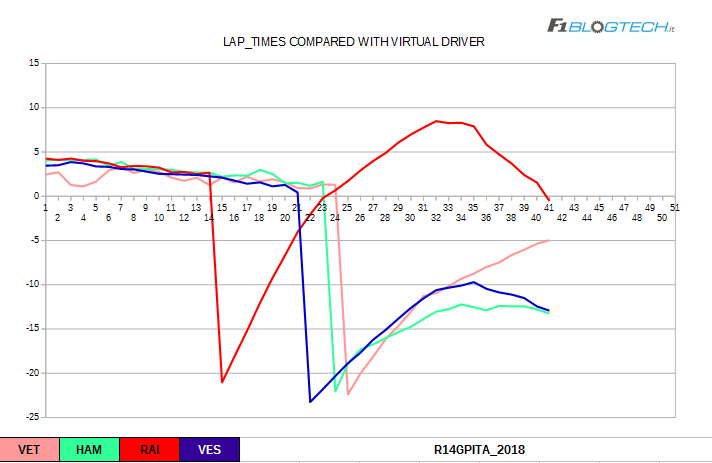
Infine, analizziamo un grafico molto interessante, quello dei distacchi. Dall'analisi del grafico si nota chiaramente il decadimento di performance. Da questo grafico si può avere una chiara idea dell'andamento della gara. Vettel ha guadagnato fino al traguardo mentre Hamilton e Vesratappen hanno peggiorato i loro tempi sul giro sul finire della gara.

I TEAM MINORI
Per le consueta analisi dei team minori, prenderemo in considerazione la gara di Ocon, di Sainz, di un sorprendente Stroll e di Charles Leclerc.
Le due Force India, fin dalle prove libere, hanno trovato il feeling giusto con il tracciato di Monza. La vettura, motorizzata Mercedes, è ormai da anni che con un badget molto ridotto riesce ad ottenere degli ottimi risultati.
Leclerc ha purtroppo spiattellato l'anteriore destra durante il primo stint e ha in parte compromesso la sua gara. Ovviamente, il grosso flat-spot ha sbilanciato la gomma e ha creato molte vibrazioni nella vettura.
Nella gara di Monza abbiamo assistito ad un'ottima gara della Williams che conserva ancora quel guizzo che aveva nei circuiti veloci alcuni anni fa.

Il primo grafico importante è quello del passo gara con la correzione dell'effetto peso. Si nota subito un buonissimo passo della Force India di Ocon rispetto a tutti gli altri durante la gara.

Inoltre proponiamo anche il grafico dell'evoluzione del 'degrado' in cui possiamo ben visualizzare l'andamento della performance dei piloti durante l'intero arco della gara.

Infine uno dei grafici più interessanti che fa capire con precisione dove i piltoi hanno perso e dove hanno invece guadagnato. Ogni Lap Time è comparato a quello di un pilota "virtuale"e costante. Vediamo che dopo il pit stop i piloti sono riusciti ad aumentare le loro performance solo sul finire della gara.

Per il momento è tutto, al prossimo appuntamento a Singapore!
Ciao e #alwayskeepushing !!
Niccolò Arnerich e Gianluca Medeot
giovedì 30 agosto 2018

The Performance Analysis of the 2018 Belgian Gp


THE BATTLE OF THE BULGE


FROM FRIDAY SIMULATIONS

What emerged during the Friday dedicated to the simulations was that the race would have been, once again, a single pit-stop. Starting with the SuperSoft rubber, if this had lasted long enough, the Soft rubber could have been fitted, otherwise it would have been possible to mount the Media rubber. The latter had shown to be quite competitive compared to other choices, as opposed to what happened on other tracks this year in which the harder compound was discarded.

As for the setup, it must be said that Ferrari has opted for a higher downforce aerodynamic package than the direct competitor. It is an advantage derived from the good efficiency of the SF71H and the extra Power Unit horses that arrived for this event. As for RedBull, the team had to look for the best aerodynamic compromise by having fewer horses than the other two top teams. They then brought a very low rear wing relying on the load generated by the bottom of the car.

Turning to the analysis of the race simulations, which took place at a temperature of 21°C, on the Ferrari of Kimi Raikkonen there was a bit of blistering on the rear left which who was 'cured' with changes to the setup. The problem with the blistering was smaller on the W09, which however suffered of a bad balance during the long runs.

Both teams, however, have decided to qualify and start with the SuperSoft tire. For the race there was nothing left to mak last as long as possible the SuperSoft rubber and then mount the Soft or the Medium tire.


THE RACE STRATEGY

CONDITIONS OF THE TRACK
The temperature of the track during the race has risen slightly compared to the Free Practice, going from 21°C to 29°C. The air temperature remained at 17°C. Some drivers were warned of a headwind at turn 12.

A QUICK SUMMARY OF THE RACE
Starting in second place, Vettel overtook Hamilton on the long Kemmel straight, just before the Safety Car came out due to the accident, unleashed by Hulkemberg, who then involved Alonso, Ricciardo and Leclerc.
For the RedBull was a two-sided race with Verstappen coming back to the third position and Ricciardo retired due to a contact in the initial crash.
Raikkonen was victim of a puncture in the first corner that ruined the race and after a few laps he retired.
The battle in the lead went ahead as an 'elastic' with Vettel who responded to the times of Hamilton.


Before starting, we propose a table with the race pace held by the drivers in order to make the reading smoother.

WHY RAIKKONEN MOUNTED THE MEDIUM RUBBER AFTER THE PUNCTURE RATHER THAN THE SUPERSOFT AS BOTTAS?
The main idea that led Ferrari to mount the Medium rubber to Raikkonen immediately after the incident was to try to go to the end, therefore remaining on the strategy of the only pit-stop. Bottas, instead, who started from the back, was forced to the pit on the first lap because of a damage to the front wing during a crash at the first corner.

 However, Mercedes opted for the red tire. This because it could be a better tire to get rid of the traffic quickly and then hope for a Safety Car to compact the group at the lead. Choosing the Medium, a tire anyway with less performance, it might have been a bit longer to get away from the slower group, but then it would not have been necessary to stop again and Raikkonen could have gone straight to the finish line. Bottas, on the contrary, would have surely have to stop another time.

WHY HAMILTON HAD BLISTERING WITH THE SUPERSOFT COMPOUND?
As we have already pointed out in the previous races, but we repeat it, the Mercedes has the characteristic of warming up a lot the rear axle tires. By mounting the Supersofts, a Low Working Ranges, therefore characterized by windows of lower temperatures, are easier to come out of the right range compared to the HighWorkingRange, characterized by a higher operating window. Going beyond the range, the rubber has less grip and overheats causing blistering. In addition to this, the car's setup did not help as the W09 suffered from oversteer exiting the slow corners.

THE ANALYSIS OF THE FIRST STINT OF THE RACE
The first graph of analysis represents the evolution of lap times during the first stint with the correction of the weight effect, ie the weight loss of the car during the race due to fuel consumption. Note that Bottas, at the beginning of the stint, being in traffic, kept a much slower pace. Verstappen, however, only in the central part of the stint managed to stay on the pace of the two in front.
The first analysis chart represents the evolution of lap times during the first stint with the correction of the weight effect, ie the weight loss of the car during the race due to fuel consumption. We note that Bottas, at the beginning of the stint, being in traffic, kept a much higher pace. Verstappen, however, only in the central part of the stint managed to stay on the two front hours.

COULD HAMILTON'S UNDERCUT WORK?
At the time of the pit stop, Vettel had managed to create a "safety" gap on his rival of about 2.8s. Experience teaches that, as happened at this year's China GP, even with a great gap, the plan can work. The criteria for the success, however, are due: first of all the driver who tries to overtake the pits must make a very fast lap, and, obviously, must not find traffic. In addition, the driver under attack must have problems with the pit that slow him down.

Then, analyzing Hamilton's intermediates immediately after the stop, it is noted that he failed to earn those 2.8s that he needed to overtake Vettel's Ferrari. The traffic of Verstappen did not affect the plan of Mercedes. Simply, the difference in performance between the old SS tire and the new S tire from Hamilton was not so pronounced as to allow the Englishman to overtake at the pits.

Finally, the stopping times between the two drivers were different from one-tenth (Hamilton: 22.3s; Vettel: 22.2

WHY THE SOFT RUBBER HAS NEVER WORKED REALLY WEEL ON THE W09?
By now we are used to see a very strong Mercedes with tires having a High Working Range. But this was not seen in the race. The W09 also suffered with the Soft rubber and were forced, even in qualifying, to pull out of the compounds from the blankets about a minute before the exit from the box. This is because with the very fast corners of Spa, where so much energy comes to the tires, the rear end of the Mercedes has difficulty staying in the right temperature range. In addition, even a few more degees of asphalt on Sunday will affect tire's life.

WHY DOES THE SF71H USES ALL THE COMPOUNDS WELL?
It is very difficult to answer this question precisely. However, it can be said that, compared to the W09, the SF71H transfers less energy to the rear tires. The car works well with LowlyorkingRange and also with HighWorkingRange tires. The amount of energy that is transferred to the tire, which then determines the temperature, is the set of aerodynamic load developed by the car, the mechanical attitude, the temperature of the asphalt, the speed of the curve, the amount of heat transmitted by the brakes and many other secondary factors.


WHY HAMILTON HAS TAKEN THE SOCKET IN THE LAST RPM?
In the last laps the Englishman gave up and started shooting on slower lap times. At the beginning one might think of a sudden performance drop in his Power Unit, but in reality Mercedes has deliberately reduced the power of the unit to save it ahead of the next event in Monza.

WAS MERCEDES TOO "CONSERVATIVE" WITH THE AERODYNAMIC PACKAGE?

The Mercedes has mounted on the W09 a more loaded aerodynamic package than Ferrari. A choice at the center of the debates these days. From the information we have collected since the beginning of the season, the W09 is less efficient, from an aerodynamic point of view, than Ferrari. So, generally, with this kind of problem, it is a higher download. The English team has said that their level of time has been tracked by Spa. In retrospect, a different choice might have guaranteed a faster  lap-time, but, with limited track tests, you have to rely on computer simulations.

ANALYSIS OF THE SECOND STINT OF THE RACE
The second stint analysis starts with the fuel correct race graph

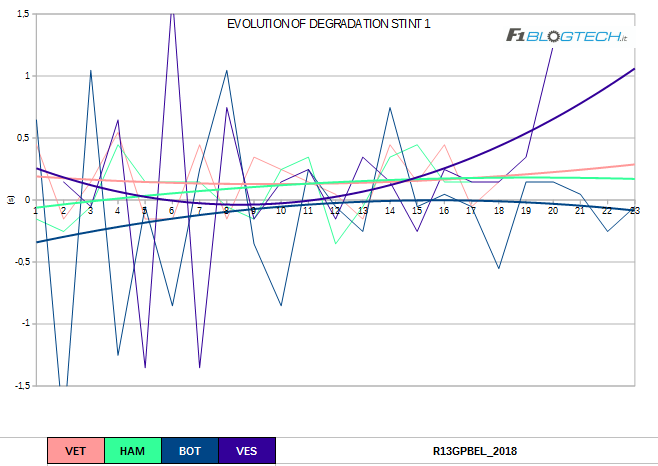
Here you have the evolution of the degradation during the last stint of the race. Every drivers has got it's own trend line.


ANALYSIS OF THE WHOLE RACE

To start the analysis of the overall race we propose the graph of the race step that we consider 'traditional' as we do not calculate the weight effect.
Continuing, we propose the graph of the race pace with the correction of the weight effect. The straight lines that are noticed are the trend lines of the various pilots.

A very interesting graph is the one related to the gaps. Each value is related to a time on the constant turn belonging to a 'virtual' pilot.
The evolution od degradation during all the race

In order to have a better view of the race strategy, we also submit the table with all the tires used by the drivers during the race session.


THE MID-FIELD TEAMS
For the analysis of the smaller teams, we analyze the race of Perez, Magnussen, Gasly and Ericsson.

A TECHNICAL REFLECTION ON THE TORO ROSSO
From what we have been able to learn in recent months, Toro Rosso, directed by James Key, has a good project in his hands, but the big problem, as for many other teams, is tire management. From what we have understood, the car does not transfer much energy into the tires and is at ease (and the results have been seen) only in the hottest circuits or with bends in which the tires are subjected to high energy. Factory work is continuing on both the aerodynamic and mechanical side, but, as mentioned, it is difficult to see the fruits of the project due to the complex tire management. Overall aerodynamic work is also very good considering that they work with a 50% model wind tunnel compared to competitors who have models up to 60%.

SOME CONSIDERATIONS ON THE INDIA FORCE
There is a lot of talk about it in the last few weeks because of financial problems. But there is to say that with the little budget available, the technical team is doing a great job. They manage to succeed in circuits like Baku and Spa, where big compromises are needed in the car setup. This is also a sign of a high level of efficiency in the car as well as a good team. Moreover, they can count on an excellent Power Unit supplied by the Mercedes group.

Also for the analysis of the smaller teams we analyze the graph of the race pace with the correction of the weight effect.
The analysis ends with the graph of the evolution of degradation throughout the course of the race.

For the moment is everything, see you at the home Grand Prix in Monza!
Bye and #alwayskeepushing !!
Gianluca Medeot and Niccolò Arnerich